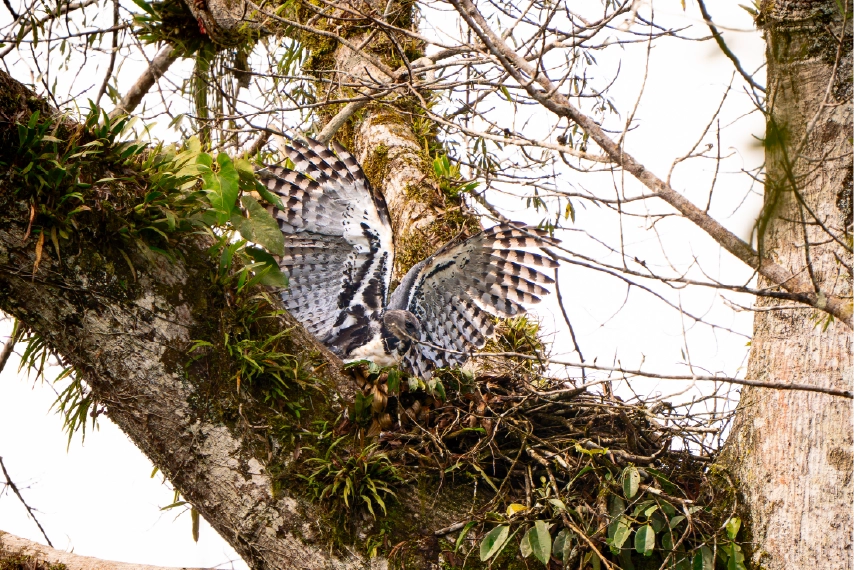
In the realm of international conservation and elite Wildlife travel, data is valuable, but biological facts are irrefutable. The confirmation of a new Harpy Eagle (Harpia harpyja) chick in the Yasuní National Park is not a random occurrence; it is definitive proof that well-executed Community-Based Tourism is one of the most effective environmental protection tools on earth.
For the Napo Wildlife Center, this milestone validates decades of a management model built on absolute respect for nature and local culture.
The Ultimate Indicator of Forest Integrity
As an apex predator, the Harpy Eagle sits at the very top of the rainforest food chain. Its survival and reproduction depend strictly on the overall health and structure of the entire ecosystem. Harpy Eagles do not nest in secondary or disturbed forests; they require biological conditions of maximum integrity:
- Primary Forest Architecture: They require giant emergent trees, primarily Ceibos (Ceiba pentandra), that soar 40 to 50 meters high. The bifurcation of their massive branches provides the only support strong enough to hold nests that can measure up to 1.5 meters in diameter.
- Abundance and Biomass of Prey: A single chick requires a constant supply of protein for nearly two years. This demands a high density of canopy-dwelling mammals, particularly two- and three-toed sloths, howler monkeys, capuchin monkeys, and coatis.
- Absence of Anthropic Disturbance: These birds are extremely sensitive to noise, heavy human presence, and habitat fragmentation. Even minor stress can cause them to abandon their nest.
The fact that this super-predator has chosen the territory of the Kichwa Añangu Community to reproduce for the second consecutive year proves that this forest remains in an optimal, self-sustaining state of conservation.
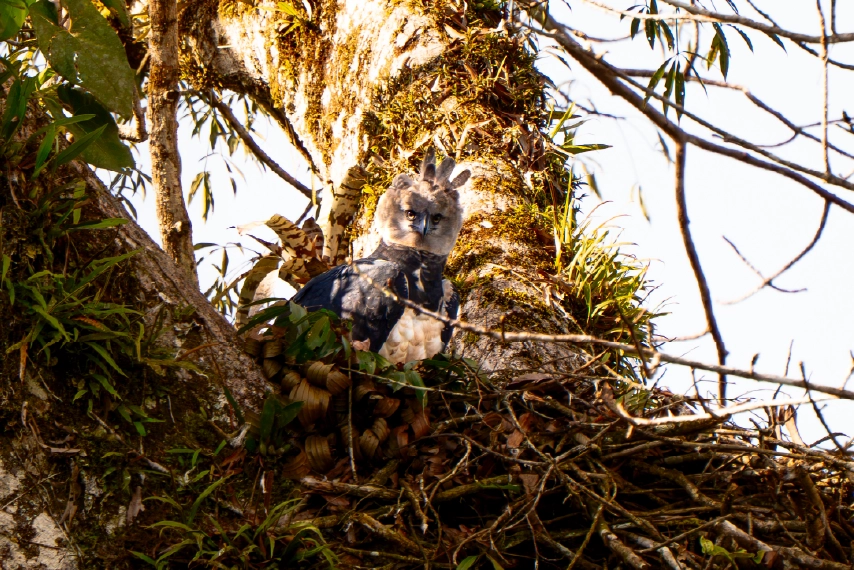
Understanding the Event: The Harpy’s Complex Reproductive Cycle
To grasp the magnitude of this event, it is vital to understand that the Harpy Eagle has one of the slowest reproductive cycles of any bird in the world.
- Breeding Every 2 to 3 Years: Females typically lay two eggs, but only one chick survives. The incubation period lasts approximately 56 days.
- Prolonged Rearing: The chick remains in the nest for 5 to 6 months but depends entirely on its parents for food for a year and a half or more, even after learning to fly.
- Strict Parental Roles: Currently, in the Añangu territory, this natural dynamic is on full display: the mother remains at the nest, actively guarding and feeding the chick, while the male meticulously hunts and transports prey from the depths of the pristine jungle.
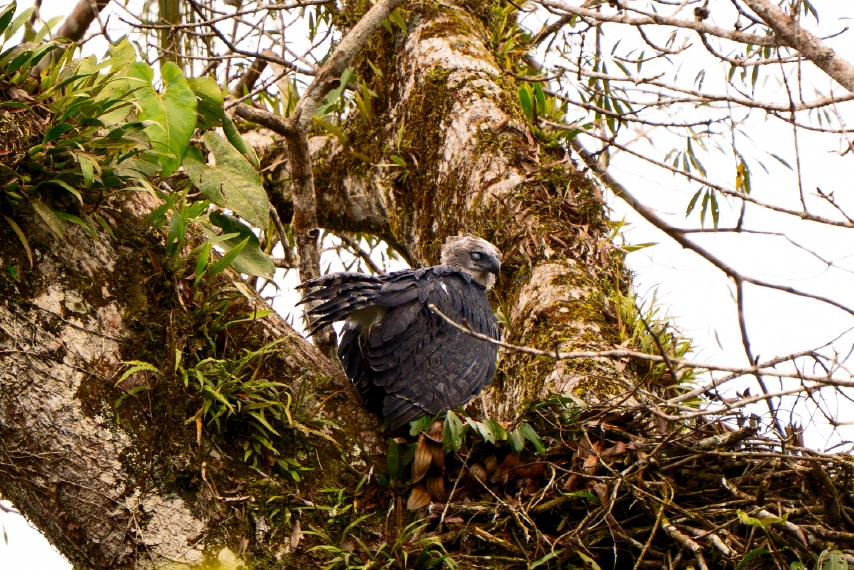
Timeline of Success in Añangu Territory
The regeneration and protection of wildlife in this sector of the Yasuní show uninterrupted biological consistency:
- August 2025: A healthy, fully developed juvenile from the previous cycle was recorded making a successful transition to independence and territorial dispersal.
- July 2026 (Present): In the exact same historic nest, the breeding pair has initiated a new cycle, confirming the presence of a healthy chick in its early growth stage.
This consecutive nesting cycle confirms that both food availability and territorial safety remain stable over the long term.
Authentic Ecotourism vs. Greenwashing
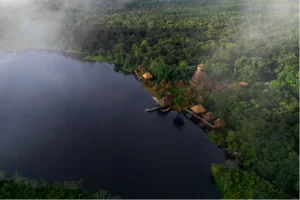
In an industry where the term “sustainable” is often used as an empty marketing phrase, the results in the Añangu territory set a different standard. This milestone is the direct result of a historic community decision: replacing extractive activities and subsistence hunting with an ecotourism project managed 100% by the local community.
The success of the Napo Wildlife Center lies in the fact that tourism revenue directly funds community rangers (who prevent poaching), biological monitoring, and environmental education. This proves that conservation and human well-being can successfully coexist.
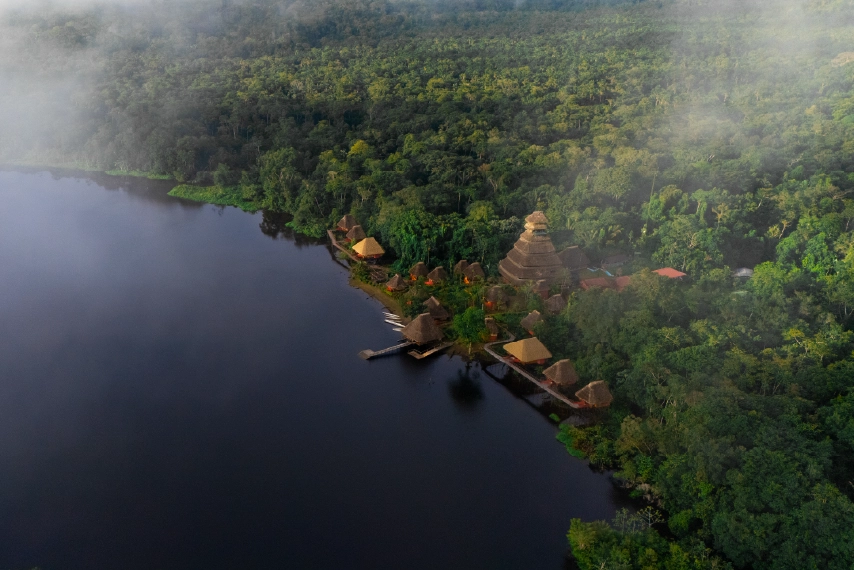
A Privilege for Conservation-Focused Observation
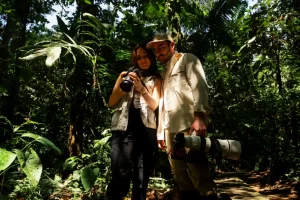
For travelers, scientists, and wildlife enthusiasts visiting the lodge, this event adds invaluable educational depth to their stay. Observing the life cycle of an endangered species, guided by the very community members who protect its home, completely redefines the travel experience.
Conclusion
The birth of this new Harpy Eagle is scientific evidence that tourism does not have to be destructive when it is built on solid ethical foundations. It is proof that the Yasuní is alive, protected by the Kichwa Añangu Community.
Do you want to witness conservation in real time?
The birth of this new Harpy Eagle is scientific evidence that tourism does not have to be destructive when it is built on solid ethical foundations. It is proof that the Yasuní is alive, protected by the Kichwa Añangu Community.